Dove Cross Embroidery Design Review
First Impression: Timeless, Calm, and Professionally Refined
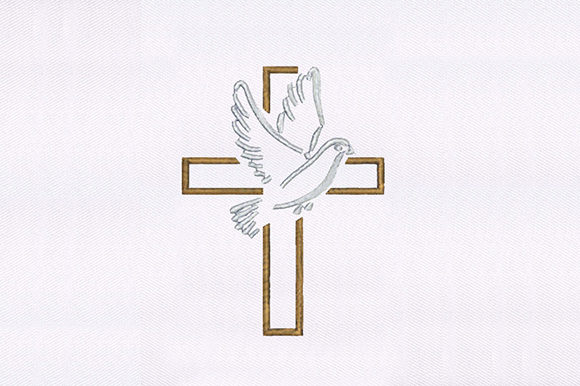
As an embroidery designer who’s digitized and stitched over 2,000 commercial designs for small businesses—from artisanal bakeries to faith-based boutiques—I opened Dove Cross expecting symbolism with subtlety. What I found was a clean, balanced machine embroidery design that leans into quiet confidence rather than ornate decoration. The title alone signals reverence and peace—ideal for brands that value authenticity, compassion, or spiritual grounding without overt proselytizing. Visually, it reads as classic and elegant, not stiff or antiquated; its proportions (2.83" × 3.77" in a 4×4 hoop) suggest intentional restraint—no overcrowded flourishes, no fragile filigree. That’s critical when you’re stitching for real-world wear: aprons that go through daily wash cycles, tote bags carried across town, or cap fronts exposed to sun and friction.
Real-World Business Use: Where Dove Cross Shines
Dove Cross excels where clarity, consistency, and emotional resonance matter most. For a local café branding staff aprons, this design anchors the chest area with quiet authority—no shouting logo needed. On a linen tote bag for a florist or holistic studio, it adds handmade product warmth without competing with floral prints or natural textures. As an embroidered patch, it holds up beautifully on denim jackets, canvas satchels, or woven backpacks—its moderate stitch count (3,341) ensures durability without excessive bulk or stiffness.
Small business merch benefits from Dove Cross in subtle but strategic ways. Etsy sellers use it as a signature accent on greeting cards with stitched borders, or sewn onto organic cotton tea towels as a branded “thank you” detail. Creative studios apply it to sleeve embroidery on unisex work shirts—small enough to avoid visual overload, large enough to read at arm’s length. Even pet brands repurpose it thoughtfully: embroidered on hemp leashes or collar tags as a gentle nod to care and protection.
For custom apparel shops, Dove Cross is a versatile asset. It scales well for cap embroidery (front panel placement works cleanly within standard curved front dimensions), and its vertical orientation makes it ideal for left-chest placement on polo shirts or lab coats. When paired with minimalist typography—like a single-line business name beneath—it builds cohesive design assets without requiring full rebranding.
Where to Use Dove Cross Thoughtfully
While Dove Cross is highly adaptable, its 4×4 hoop size and defined outline mean certain applications require extra attention. Avoid shrinking it below 2.2" in height—especially for small patch sizes or curved cap backs—where fine detail may collapse or lose definition. On textured fabric like heavy twill or looped terry cloth, test stitch density first: the design’s clean lines rely on stable registration, so high-pile surfaces need medium-cutaway stabilizer, not tear-away alone.
Dark uniforms? Confirm thread color contrast early. Dove Cross doesn’t include built-in shading or gradients, so monochrome execution (e.g., white thread on navy) depends entirely on your chosen palette—test it in black and white first to verify legibility. Also note: while the design fits neatly in a 4×4 hoop, always confirm your embroidery file includes precise centering data before batching production. Misaligned placement on 50+ aprons means costly rework.
Brand Identity Impact: Trust, Recognition, and Quiet Authority
In small business branding, symbols carry weight—and Dove Cross communicates integrity without pretense. Unlike trend-driven motifs, it supports long-term brand identity by evoking calm, sincerity, and grounded values. Customers subconsciously associate that feeling with trust—especially in service-based or wellness-oriented businesses (think: yoga studios, counseling practices, herbal apothecaries). It elevates perceived product value: a simple cotton tote with Dove Cross feels intentionally crafted, not mass-produced.
For handmade product sellers, this design reinforces authenticity. Its clean execution avoids looking “clip-art,” and its religious category context doesn’t limit usage—it deepens narrative. A bakery named “Grace & Crumb” uses it beside a wheat motif on packaging tags; a pet rescue embroiders it on volunteer vests. In each case, Dove Cross strengthens visual consistency across touchpoints—whether on a printable mockup shared with clients or stitched directly onto merchandise.
Practical Designer Notes for Commercial Embroidery
Before committing Dove Cross to production:
- Test it in black and white first—verify shape integrity and edge sharpness across thread colors.
- Check minimum viable size: does it retain clarity at 2.2"? If not, adjust underlay or simplify fill areas before scaling down.
- Review thread color contrast on your target fabric—especially for dark or heathered textiles.
- Inspect spacing between elements: tight gaps may close up on knit fabrics or low-tension machines.
- Confirm hoop size compatibility—this is a 4×4 design, so avoid forcing it into smaller hoops without digitizing adjustments.
- Always test on real fabric with your intended stabilizer: cutaway for caps and uniforms, tear-away for lightweight totes.
- Create a physical or digital mockup for client approval—Dove Cross reads differently stitched vs. on-screen.
- Compare it beside other design assets (logos, fonts, icons) to ensure visual harmony—not just thematic alignment.
- Verify commercial licensing: since this is a digital embroidery file for business use, confirm redistribution rights if selling finished embroidered patches or apparel.
Finally—don’t skip the basics. Even a refined machine embroidery design like Dove Cross depends on proper hooping, tension calibration, and fabric prep. Its 3,341 stitches are efficient, not forgiving. When executed well, it becomes more than decoration: it’s a quiet signature of care, consistency, and craft—exactly what small businesses need to stand out with meaning.